Date: February 11th, 2026
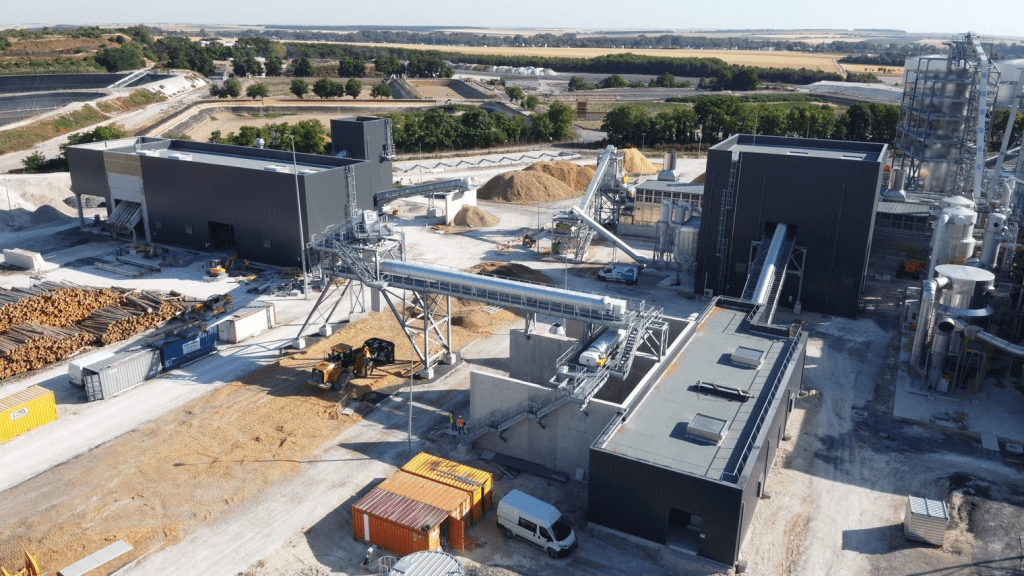
Figure 1. A biomass pellet facility and storage/handling infrastructure—illustrating the scale of the pellet supply chain behind “renewable” biomass energy.
The “Green Energy” Contradiction
What struck me most in this week’s materials is the contradiction embedded in the term green energy. Europe has classified wood pellets as renewable, allowing countries to meet climate targets by burning biomass instead of coal. Yet investigative reporting shows that many of these pellets come from mature, and in some cases protected, forests.¹ Because trees can regrow, the practice is categorized as carbon-neutral. However, that framing overlooks two critical realities: the immediate release of carbon dioxide when wood is burned and the decades required for forests to reabsorb that carbon.
Why Timing Matters: Carbon Debt and the “Gap”
This temporal gap deeply unsettled me. Climate policy often operates on accounting frameworks that treat emissions and regrowth as balanced over time. But from an ecological perspective, the timing of emissions matters. If carbon is released today and only reabsorbed decades later, atmospheric concentrations rise in the meantime, intensifying warming. In other words, the classification of biomass as “renewable” depends on a long-term assumption that may not align with urgent climate goals.
Policy Incentives Can Create the Problem
What made the situation even more troubling is that these practices are not accidental. They are financially supported through subsidies meant to accelerate clean energy transitions. Policies designed to reduce emissions are, paradoxically, encouraging forest harvesting on a large scale. This reveals a broader lesson about sustainability: what counts as “renewable” is not purely scientific — it is also political.
Energy Security Pressures and Short-Term Tradeoffs
At the same time, the energy security context complicates the issue. Europe’s push toward biomass accelerated after disruptions in fossil fuel supply, particularly following geopolitical instability. Governments faced immediate pressure to replace coal and natural gas quickly. In moments of crisis, policymakers often prioritize short-term stability over long-term ecological nuance.
Alternative Pathways: Integrated Systems and SMRs
This tension raises a broader systems question: if renewable classifications can produce unintended ecological harm, what alternative pathways exist?
One possibility comes from research on integrated energy systems combining renewables with small modular reactors (SMRs). El-Emam and Subki argue that SMRs could provide flexible, low-carbon baseload power that complements variable renewables like wind and solar.² Unlike biomass, nuclear energy does not depend on carbon reabsorption over time; its lifecycle emissions are low and do not rely on forest regrowth. The article also highlights hybrid systems that integrate storage and dynamic grid management to reduce variability challenges.³
Of course, nuclear energy brings its own safety, regulatory, and financial concerns. But the comparison highlights something important: not all low-carbon solutions carry the same ecological trade-offs. Biomass framed as renewable may still degrade ecosystems, while other technologies pose different — though serious — risks.
Closing Reflection
Ultimately, this week’s materials made me reconsider how sustainability is defined. Labeling something “green” does not automatically make it ecologically benign. Climate policy is shaped by accounting methods, economic incentives, and political urgency — not just atmospheric science.
Question I’m Left With
How should policymakers weigh urgent energy security demands against long-term ecological costs, and who has the authority to define when that tradeoff becomes unacceptable?
If climate policy is a balancing act between time scales, ecosystems, and human needs, then deciding where to draw that line is not merely technical — it is ethical.
Footnotes
- Somini Sengupta and Manuela Andreoni, “Europe Is Sacrificing Ancient Forests for Energy,” New York Times, September 7, 2022.
- Rami S. El-Emam and M. Hadid Subki, “Small Modular Reactors for Nuclear-Renewable Synergies: Prospects and Impediments,” International Journal of Energy Research 45, no. 11 (2021).
- El-Emam and Subki, “Small Modular Reactors,”.
Word Count: 522 words
 Enviromental Studies Blog
Leave a comment