Date: January 26th, 2026
During our sustainability backcasting activity, our group imagined a future in which food waste in the United States is reduced by roughly 50% by 2050, lowering total waste levels to about 15–20 percent. In this future, Americans move away from bulk purchasing, overconsumption, and prioritizing visually “perfect” food. Instead, food is treated as a resource with environmental, social, and economic value.
I was drawn to this topic because food waste feels invisible. Unlike climate change or air pollution, it hides in trash bins and supply chains. Yet it represents wasted water, land, energy, and labor. Backcasting asks us to first define a desirable future and then work backward to determine how to achieve it.¹ Rather than assuming gradual improvement, it encourages systemic redesign. Food waste seemed like an issue that requires exactly that kind of thinking.
Our Envisioned Future and Pathways
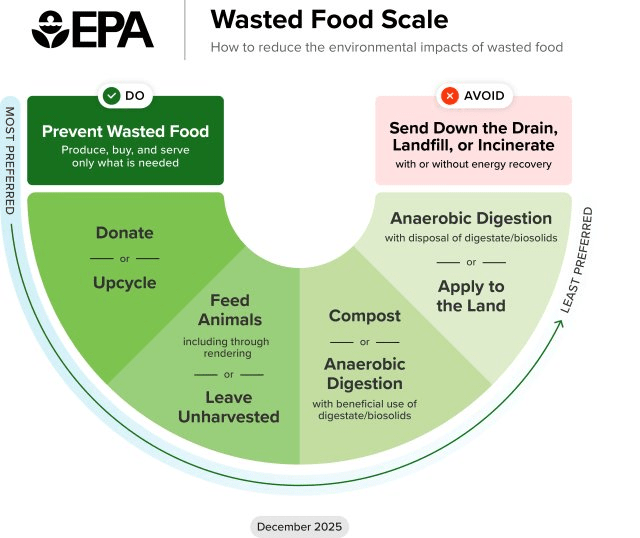
Figure 1. EPA’s Wasted Food Scale shows a hierarchy for reducing the environmental impacts of wasted food, prioritizing prevention and donation over disposal options like landfill or incineration.
Our 2050 vision combined cultural change, government action, and structural reform within the food industry.
First, we emphasized education and cultural transformation. We proposed integrating food sustainability and waste reduction into school curricula to reshape long-term consumption habits. Cultural change is slow, but it addresses root causes rather than symptoms.
Second, we discussed economic incentives and policy measures, such as tax benefits for food donations, standardized date labeling laws, and potential penalties for excessive waste. These tools align market signals with sustainability goals. However, they also raise concerns about equity and enforcement, especially across different states and income groups.
Third, we highlighted expanding awareness of existing tools like the app Too Good To Go, which connects consumers to surplus food. While these solutions create immediate impact, they operate within a broader system still structured around overproduction.
Sustainability literature emphasizes that true sustainability is multidimensional, involving environmental protection, equity, and long-term systemic change.² Our group tried to reflect that by including ethical considerations and food access alongside environmental goals.
Challenges and Knowledge Gaps
The greatest challenge we identified was cultural resistance. Overconsumption is deeply embedded in American consumer culture, where food is relatively affordable and waste is normalized. Changing behavior across a large and diverse population requires long-term commitment and public trust.
We also recognized structural barriers. Businesses may overproduce because surplus is economically safer than precision. Backcasting research notes that systemic change requires coordination across multiple stakeholders, which is often difficult to sustain in practice.³
This activity revealed gaps in my knowledge, particularly regarding how large-scale sustainability policies are implemented and enforced without increasing inequality. I also realized I need a deeper understanding of food supply chains and international examples of successful food waste reduction.
Overall, this exercise showed me that reducing food waste is not just about individual responsibility. It requires coordinated policy, cultural transformation, and economic restructuring. Backcasting helped shift my thinking from short-term fixes to long-term systemic pathways — a perspective I hope to strengthen throughout this semester.
Footnotes
- Philip J. Vergragt and Jaco Quist, “Backcasting for Sustainability: Introduction to the Special Issue,” Technological Forecasting & Social Change (2011).
- Ibid
- Ibid
Word Count: 509 words
 Enviromental Studies Blog
Leave a comment