Date: February 18th, 2026
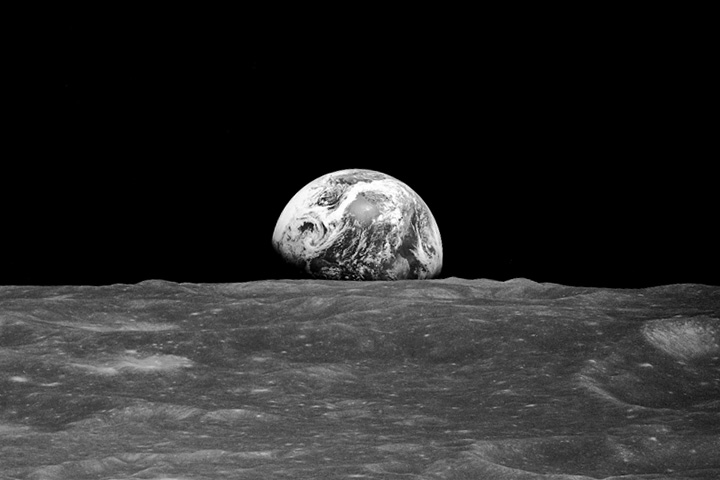
Figure 1. “Earthrise” (Apollo 8, 1968) became an iconic “Spaceship Earth” image—powerful for building unity, but it can also encourage a universal framing that risks obscuring unequal environmental burdens.
Why Reform Environmentalism Feels So Convincing at First
Reading Chapter 8 reshaped how I think about mainstream environmentalism. Reform Environmentalism is presented as the dominant environmental discourse of the modern era, rooted in natural science and the idea that human survival depends on ecosystem stability.¹ At first, this framework feels reassuring: it links public health to environmental protection and relies on scientific expertise to guide policy. But as the chapter progresses, it becomes clear that this approach, while powerful, is also limited.
Origins: Public Health, Sanitation, and Environmental Regulation
I found the historical origins particularly interesting. The early sanitary movement linked disease to environmental conditions like polluted water and urban filth, leading to sewer systems and municipal reforms.² This connection between environmental conditions and human health laid the foundation for modern environmental regulation.
Later, Rachel Carson’s Silent Spring reunited ecological science with public health concerns, exposing how industrial chemicals threatened both ecosystems and people.³ That moment seems pivotal — it transformed environmental protection into a mass political movement and led to major legislation in the 1970s, including the creation of the EPA.⁴
The Core Critique: A Technocratic Approach to a Political Problem
What struck me most was the critique of Reform Environmentalism’s structure and politics. Despite its scientific strengths, Bruelle argues that the discourse is partial: it identifies ecological consequences but often ignores the deeper social and economic causes of environmental degradation.⁵ Environmental problems are framed as technical failures requiring expert management, rather than outcomes of political and economic systems. The solution becomes regulation, litigation, or incremental reform — what the chapter calls “science-based piecemeal reform.”⁶
Who Gets Represented? Organizations, Funding, and Power
Another troubling point is the organizational structure of reform environmental groups. The chapter notes that more than two-thirds are oligarchic in form, meaning decision-making power is concentrated among elites rather than widely distributed among members.⁷ Many rely heavily on foundation funding, which increases the risk of co-optation or becoming “Astroturf” organizations.⁸ This raises important questions about representation: if environmental organizations are structured hierarchically and financially dependent on external funding, how effectively do they represent diverse communities and grassroots concerns?
“Spaceship Earth” and the Risk of Flattening Inequality
The discussion of the “Spaceship Earth” image also stayed with me. While it promotes unity and shared fate, Bruelle suggests it can erase social and economic inequalities by presenting environmental crisis as universally shared.⁹ That framing may obscure who benefits from current systems and who bears the greatest environmental burdens.
Takeaway
Overall, this chapter made me reconsider whether science alone is enough to drive ecological change. Reform Environmentalism achieved major legislative victories in the 1970s, yet ecological degradation has accelerated in recent decades.¹⁰ If the discourse is politically narrow and technocratic, it may struggle to mobilize broader democratic engagement.
Question
If Reform Environmentalism relies heavily on scientific expertise and elite-led organizations, how can environmental movements build broader democratic participation without losing the credibility and authority that science provides?
Footnotes:
- Steven M. Buechler (Bruelle), Chapter 8: Reform Environmentalism: Public Health and Ecology, in [Book Title], 174.
- Bruelle, chap. 8, 176–177.
- Bruelle, chap. 8, 182–183.
- Bruelle, chap. 8, 186–188.
- Bruelle, chap. 8, 192.
- Bruelle, chap. 8, 192.
- Bruelle, chap. 8, 190.
- Bruelle, chap. 8, 192–193.
- Bruelle, chap. 8, 187–188, 192.
- Bruelle, chap. 8, 191.
Word Count: 506
 Enviromental Studies Blog
Leave a comment