Date: February 25th, 2026
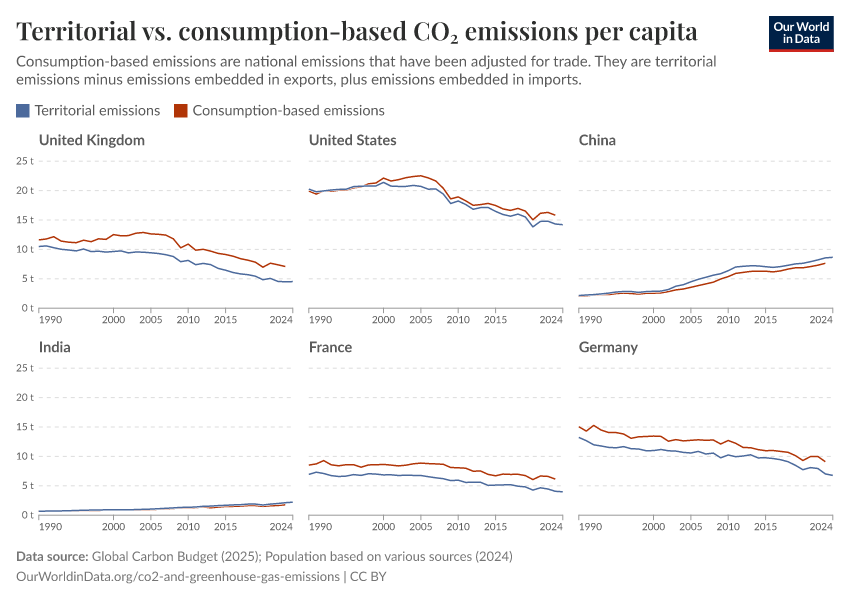
Figure 1. Territorial (production-based) vs. consumption-based CO₂ emissions per capita—showing how a country can appear to cut emissions domestically while still driving emissions abroad through imported, carbon-intensive goods.
Growth Has Historically Meant More Emissions
This week’s readings pushed me to think more critically about the relationship between economic growth and climate change. The Guardian interactive highlights a central tension in climate policy: historically, economic growth has been tightly linked to rising carbon emissions. Industrialization, energy use, transportation, and consumption all expand GDP — but they also increase fossil-fuel combustion. The core question becomes whether economies can “decouple” growth from emissions fast enough to avoid catastrophic warming.
The Outsourcing Problem: “Progress” That Moves Emissions Elsewhere
What stood out to me is how uneven that decoupling has been. Some wealthy countries have reduced territorial emissions while continuing to grow economically, but much of that reduction is tied to outsourcing manufacturing and importing carbon-intensive goods. This makes it difficult to determine whether true structural decoupling is occurring or whether emissions are simply shifting geographically. The interactive format made this visually clear: global emissions continue rising even as individual nations claim progress.
Why Climate Damage Models Disagree So Much
The Atlantic article deepened this tension from an economic perspective. Noah Kaufman argues that economic models estimating climate damages often produce wildly different conclusions — from modest long-term losses to catastrophic reductions in global income.¹ These models depend heavily on assumptions about adaptation, technological change, and how damages scale with temperature increases. Small shifts in assumptions can justify either limited climate action or urgent, aggressive decarbonization.
Uncertainty Isn’t a Minor Detail — It Shapes Politics
What unsettled me most is Kaufman’s claim that economists cannot confidently determine which future is coming.² Models can simulate outcomes, but they cannot eliminate deep uncertainty about tipping points, human adaptation, or nonlinear climate impacts. That means policy debates often lean on damage estimates that appear precise but may be deeply fragile.³
Growth, Definition, and Equity
This creates a dangerous political dynamic. If climate damages are projected to be modest, policymakers can justify continued growth powered by fossil fuels. If damages are projected to be catastrophic, advocates argue for drastic economic restructuring. But both positions may rely on models that overstate what economics can truly predict.
The broader issue is how growth itself is defined. Reform environmental discourse has historically assumed that technological improvements and regulatory frameworks can reconcile economic expansion with ecological protection. However, if economic growth continues to depend on material extraction and energy throughput, then absolute decoupling may be more difficult than optimistic models suggest.
At the same time, abandoning growth entirely raises serious equity concerns. Many developing countries still need economic expansion to reduce poverty and improve health outcomes. Climate policy cannot simply demand stagnation in the Global South while wealthy nations continue high consumption patterns.
Takeaway
Overall, these readings made me realize that the growth-versus-climate debate is not just about emissions trajectories — it is about uncertainty, risk tolerance, and values. If economists cannot definitively quantify future damages, then climate policy becomes less about optimization and more about precaution.
Question
If economic models cannot reliably determine whether climate damages will be modest or catastrophic, should climate policy prioritize risk management (treating worst-case scenarios as decisive) rather than cost-benefit optimization?
Footnotes:
- Noah Kaufman, “The Climate Question That Economists Cannot Answer,” The Atlantic, January 14, 2026.
- Kaufman, “The Climate Question That Economists Cannot Answer.”
- Ibid
Word Count: 523
 Enviromental Studies Blog
Leave a comment